
Sedgwick Court Records After Jail Arrest
Court records after a jail arrest in Sedgwick County usually start with a local booking at the Sedgwick County Adult Detention Facility, then move to the 18th Judicial District Court when a prosecutor files the case. The Sedgwick County District Attorney is Marc Bennett. His office prosecutes adult criminal cases through divisions that include general trial, economic crime, gang and violent crime, and domestic violence or sex-crime units. That prosecuting role matters because the jail does not decide the final charge list. The jail records the arrest and booking data. The DA decides what criminal charges to file, amend, dismiss, or pursue in court.
A booking charge can be broader, less complete, or different from the filed court charge. The custody side is handled through the Sheriff and is better matched to Sedgwick County jail inmate records. The court side is handled by DC18 records and the Kansas District Court Public Access Portal. Booking photos and public display limits are a different issue, covered by Sedgwick County jail mugshots. For court records after an arrest, focus on filed charges, case number, hearing history, warrants, bond orders, dispositions, and expungement status.
Find Sedgwick Court Records After Arrest
The 18th Judicial District Court Records department maintains criminal, civil, domestic, probate, traffic, support, microfilm, microfiche, and electronic district court records for Sedgwick County. Public access has two main paths. A person can visit the Court Records department at the courthouse, 525 N. Main, 6th floor, in Wichita and use public access computers. A person can also use the Kansas District Court Public Access Portal, which requires registration, login, and a robot check for public users. DC18 says public users may search by party name or case number. Kansas Courts also describes online public access and in-courthouse access as separate routes.
- Start with the defendant name as it appears in the jail booking record, citation, or warrant entry.
- Search the Kansas portal by party name, or use the case number if it is known from a charging document, court notice, or warrant result.
- Open the matching criminal case and compare the filed charge list with any booking charges shown by the Sheriff.
- Review each charge for level, current status, bond orders, hearing dates, and disposition before treating the record as final.
The portal is not a complete criminal-history tool. Sedgwick County's KORA materials point users to the KBI for criminal-history record information, to KASPER for Kansas Department of Corrections status, to district court records for filed cases, and to the Sheriff's tools for current jail custody and warrants. A statewide criminal-history report, a jail roster entry, and a court case record answer different questions. Court records after a jail arrest show how one filed case moves through court, not every past contact with law enforcement.
| Search Field | Type | Required | Notes |
|---|---|---|---|
| Party Name | Portal search | Login required | DC18 identifies party-name search for public portal users. |
| Case Number | Portal search | Login required | Best way to match jail charges, warrants, and filed court records. |
| Business Name | Portal search | Role dependent | Listed by the Kansas Case Search landing page. |
| Citation or Other Criteria | Portal search | Role dependent | Access may depend on account type and case category. |
The DC18 Records page explains the courthouse terminal option and the portal route for Sedgwick County court records after an arrest.
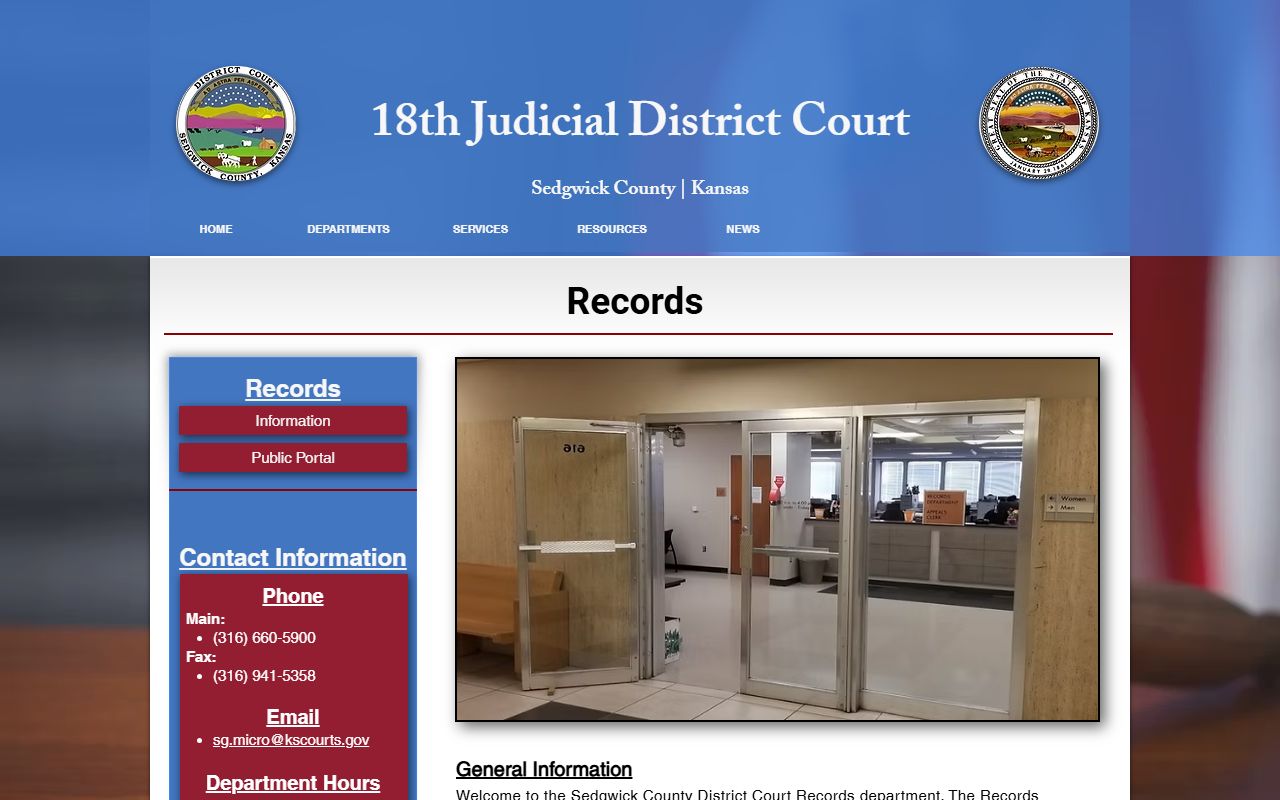
That court records source is the right place to check filed charges once the jail arrest has moved into a criminal case.
Sedgwick Arrest Charges and Court Filings
The arrest-to-court path is simple in outline but easy to misread. A person may be arrested by Wichita Police, Sheriff's deputies, a municipal agency, a state officer, or a federal agency, then booked into the Adult Detention Facility. The booking record may list an arrest charge, warrant type, holding agency, or bond amount. The court record begins when a complaint, information, or indictment is filed. Prosecutors may file fewer charges than the booking entry showed, add different counts, change the severity level, or decline to file a charge at all. Grand jury and indictment procedures are less common and case-specific.
| Document | Who Uses It | What It Does | Sedgwick County Notes |
|---|---|---|---|
| Complaint | Prosecutor or law enforcement through court process | States the criminal accusation that starts or supports the case. | Often the first filed document after a jail arrest or warrant arrest. |
| Information | Prosecutor | Sets out the formal charge that the DA elects to pursue. | Common in felony prosecutions after review by the District Attorney. |
| Indictment | Grand jury | Accuses a person after grand jury proceedings. | Less common, and access may be limited because grand jury materials can be restricted. |
The most useful comparison is not "arrest record versus court record" in the abstract. It is the difference between a jail booking charge and the charge actually filed in Sedgwick County District Court. Use the booking record to understand why the person entered custody. Use the court record to see what charge the case is built on and whether that charge is pending, amended, dismissed, or resolved by plea, trial, or diversion.
Sedgwick Charge Status Records
Charge status can change more than once after a jail arrest. A case may start with one charge, then move to a different level after prosecutor review, plea negotiation, preliminary hearing, or dismissal of a count. Sedgwick County jail records may also show abbreviations from the Sheriff's code list, such as AW for alias warrant, BW for bench warrant, CW for complaint warrant, FTA for failure to appear, PV for parole violator, and BICE for Bureau of Immigration and Customs Enforcement. Those codes help interpret custody, but they do not replace the court docket.
| Status | What It Means | How to Read It |
|---|---|---|
| Pending | The charge is still active in court. | Check hearing dates, bond orders, and any amended filings before assuming outcome. |
| Amended or Reduced | The filed charge changed from an earlier version. | Compare the first charge entry with the current count and statute description. |
| Dismissed | The court record shows the count or case did not proceed to conviction. | A dismissal is not the same as automatic expungement or removal from every index. |
| Nolle Prosequi | The prosecutor elected not to pursue a charge. | Review the docket text and case disposition because wording can be case-specific. |
| Convicted | A plea or verdict resulted in guilt on that charge. | Sentenced state-prison custody may later move to KDOC and KASPER. |
Bond Orders After Sedgwick Arrest
Bond in Sedgwick County is controlled by the judge and court, not by the jail alone. The Sheriff's bond page says bond amounts shown are for the charge on the same line, so multiple lines may need to be added to estimate total bond. It also warns that a displayed $0.00 is not a promise of free release. It can mean no bond is allowed, a judge ordered no bond, or more than one charge is booked under one case number. Some inmates cannot bond because they are serving a sentence, waiting on a transport order, held on a state arrest and detain order, or held on a parole violation.
| Bond Type | How It Works in Sedgwick County |
|---|---|
| Cash Only | Some courts or charges require cash. Personal and business checks are not accepted, and the receiving court controls final disposition of posted cash. |
| Professional Surety | An inmate may use a bail bondsman or post full cash. Bail company fees are civil matters outside Sheriff refund control. |
| Own Recognizance | Qualified inmates sign a promise to appear. Local metro residency includes Sedgwick, Harvey, Butler, Sumner, Reno, or Kingman counties. |
| No-Bond Hold | State arrest and detain orders, parole violations, juvenile holds, some transport orders, and judge-ordered no-bond cases can block release. |
Bond is part of both the custody record and the court record. The jail may show a bond column for each charge line, while the court record shows the order that controls release terms. Domestic violence arrests may involve a court-ordered cooling-off period before bond. Out-of-state warrant inmates may need an 18th Judicial District Court judge to set bond before any release path exists.
Sedgwick Warrants and Arrest Records
Sedgwick County has an official Sheriff warrant search and a separate warrant information page. The Sheriff's warning is direct: do not try to take action if a wanted person is located. Call the Sheriff's Office at 316-660-3960, 800-874-6449, 911, or local law enforcement. Tips can also go to Crime Stoppers of Wichita/Sedgwick County at 316-267-2111. A warrant arrest may lead to booking at the Adult Detention Facility and then to a court case if the person is still in custody or appears on the warrant matter.
Warrant search results may include name, race, sex, date of birth, height, weight, case number, warrant type, charge, felony or misdemeanor level, and bond. Bench warrants and arrest warrants do not always mean the same thing. A bench warrant often comes from failure to appear or a court order in an existing case. A complaint warrant can be tied to a new accusation. Lower court and municipal warrants may require contact with the issuing court for exact status.
Sedgwick Charges vs Convictions
An arrest and a charge are accusations. A conviction is a result after a plea, verdict, or other legally recognized finding of guilt. The Sedgwick inmate search itself warns that listed persons are presumed innocent unless convicted in court. That warning is important when reading court records after a jail arrest. A public case may be open, amended, or dismissed before any final outcome exists.
| Point of Comparison | Charge | Conviction |
|---|---|---|
| Stage | Accusation filed or listed after arrest. | Final result through plea, verdict, or judgment. |
| Proof | Based on arrest facts, probable cause, or prosecutor review. | Requires a legal finding of guilt under criminal procedure. |
| Record Meaning | Shows what the person was accused of. | Shows the charge that ended in guilt and sentencing. |
| Lookup Source | Jail roster, warrant search, and court filing may each show it differently. | District court record and, after prison transfer, KDOC records may show it. |
Sealed and Expunged Sedgwick Records
Kansas law gives some people a path to clear eligible arrest or case records, but the words sealed and expunged should not be treated as automatic outcomes. K.S.A. 22-2410 addresses arrest-record expungement and purging through district court. K.S.A. 21-6614 governs expungement of certain convictions, arrest records, and diversion agreements. DC18 and Kansas Case Search also exclude arrest expungement records and sealed or confidential documents from public portal access. If a charge was dismissed, that may help eligibility, but a court process is still required.
| Point of Comparison | Sealed | Expunged |
|---|---|---|
| Public Visibility | Hidden or restricted from ordinary public view. | Treated through a statutory clearing process when eligible and ordered. |
| Where It Appears | May be blocked from the public portal or courthouse public terminals. | Expunged arrest records are excluded from public Kansas portal access. |
| How It Happens | By rule, court order, confidentiality law, or case type. | By petition or court process under Kansas expungement statutes. |
| Practical Limit | Some officials may retain limited access. | Private copies or older third-party copies may not vanish at the same time. |
KORA Limits on Sedgwick Court Records
Kansas Open Records Act access starts with the policy in K.S.A. 45-216, which says public records are open unless the law provides otherwise. K.S.A. 45-218 governs inspection requests, responses, refusals, and fees. Sedgwick County says agencies must respond within three business days. A KORA request should identify existing records by date, time, person, agency, case number, and requested format. The county does not have to create new research, answer legal questions, or compile a custom report that does not already exist.
Important: This private reference page is not a consumer reporting agency, and records found here or through linked tools may not be used for FCRA-covered screening.
Some records are restricted. DC18 says public portal users cannot see adoptions, guardianship or conservatorship, care and treatment, coroner inquest, some domestic cases, grand jury matters, protection-from-abuse or protection-from-stalking cases, juvenile CINC and juvenile offender matters, arrest expungement records, some miscellaneous or inquisition matters, sealed or confidential documents, and non-docketable events. K.S.A. 45-221 also lists open-records exemptions, including criminal-investigation records. For county records not found online, use the Sedgwick County KORA form or email kora-fio@sedgwick.gov. For Sheriff arrest or disposition letters about yourself, Sheriff Records can be reached at 316-660-3888.